Wednesday, September 24, 2008

Who’s Afraid of the Empowered Patient?

Who’s Afraid of the Empowered Patient?

Delia Chiaramonte, MD, Baltimore, Maryland
dc@insightmedicalconsultants.com

JAMA. 2008;300(12):1393-1394.

From today's JAMA:

"...Yet patients can be stingy too—stingy with their respect and their gratitude. For all our hard-earned knowledge and personal sacrifice, don't we deserve a little reverence? Of course we do. However,whether we deserve it or not is irrelevant because times have changed. Patients are no longer passive and adoring, and our relationship is no longer hierarchical and paternalistic. It is when we see this change as a demotion, rather than as an evolution, that our hackles get raised.

Rather than being impressed by their patients' empowerment or inspired by their quest for wellness, some physicians are suspicious and occasionally blatantly hostile toward patients who demand an active role in their health care. We physicians enjoy our kingdoms and we don't take kindly to challengers. Yet the occasional physician who embraces her patient's empowerment often discovers a gem—a patient who is engaged, adherent, and motivated to get well."

My favourite part:

"A truly empowered patient is the ideal patient. Empowered patients will challenge us, yes, but they will also take their medicine and go for their tests. They will ask when they don't understand our instructions rather than simply ignoring them. And, most important, they will be more likely to get well, which will make us feel successful....

...Is there a solution? Can physicians and patients get back on the same team? I think we can."

Marina: patients and doctors should be on the same team - not adversaries!

Your thoughts?

Sunday, September 21, 2008

Do Not Forget the Patient: Tyranny of Diagnosis

Do Not Forget the Patient: Tyranny of Diagnosis

From "DB's Medical Rants" opens with this quote:
"

The concept of disease, Professor Rosenberg writes, has historically focused on the individual — a single person’s experience, story and sense of meaning.

Over the last century and a half, however, medicine has increasingly decoupled disease from the individual. This decoupling has given rise to the concept of precise, objective and quantifiable diagnoses, diagnoses so separate from patients that they seem in many ways to take on a life of their own.

Diagnoses cluster together by specific physiologic mechanisms, signs and symptoms, pathologic findings. They have insinuated themselves into health care economics as DRG’s, or Diagnosis-Related Groups, which drive physician compensation. They have inspired whole subspecialty training programs and huge advances in how we understand and treat them. Think of heart failure, cancer and my own specialty, liver transplantation.

This greater understanding and improved treatment are important and good news for all, no doubt.

Yet along with these great clinical strides, diagnoses have also fomented their own cultural revolution. Diagnoses have changed the way we approach individuals."

His summary: "Great physicians treat patients. We need to refocus medical care on patients, while considering diagnosis as an important but not a trumping factor."

Marina: What are your thoughts?


Friday, September 19, 2008

The EHR discussion

Reading this morning Vince Kuraitis' blogpost, made me realise why I accepted Carlos' very kind invitation to become a guest writer to this blog.

Allow me to briefly introduce myself. I'm Lodewijk Bos, President of the ICMCC Foundation, the only global organisation that deals with patient-related ICT. For more see our website www.icmcc.org. We also bring a well visited news page on medical and care ICT related matters.
Recently I was first author of an article called the impatient patient. And that's how Carlos found me.

Back to Kuraitis' blogpost, called From PHRs to PHRSs.
After Katharina, in the US the idea that the patient should have his own record, a PHR, which should be independent from the "pure" medical record, was given an enormous impulse. (for more see Paul Tang et al.) From that moment on I have been fighting this concept in many of my blogs, articles and speeches.

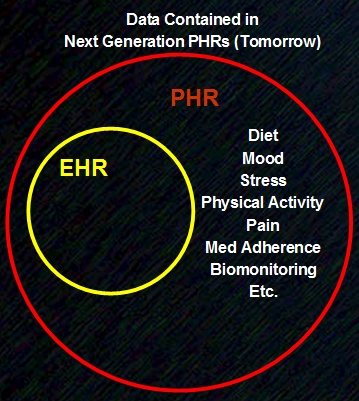
Now, in his blog, Kuraitis turns around the wheel completely. (see picture)
You can discuss whether it should be the way Kuraitis proposes or the way I have been promoting, where the PHR is an integral and equal part of the EHR, i.e. PHR + EMR = EHR.

But the fact that it took 3 years to come up with the concept that the new generation PHR should be an integrated record where I, and many others with me, have been saying this over and over again, makes me an impatient patient.


Tuesday, September 16, 2008

E.R. Patients Often Left Confused After Visits

E.R. Patients Often Left Confused After Visits
Published: September 16, 2008
From the article:

Many emergency room patients are discharged without understanding how to care for themselves once they get home, researchers say.

In the past, patients who did not follow discharge instructions were often labeled noncompliant. “Now, it’s being called health illiteracy,” Dr. Coleman said, adding that as many as half of all patients are considered to lack the ability to process and understand basic health information that they need to make decisions.

But the patient is only part of the equation, he continued; doctors are notoriously inept at communicating to patients.

The new study found that people were not aware of what they did not understand, suggesting that simply asking a patient if he understands is not enough.

“We’re good at saying, ‘Here’s the information, any questions?,’ ” Dr. Coleman said, “and the person nods his head, but they don’t get it.”


Marina: It all boils down to a lack of information...and ability to transfer information...

Monday, September 15, 2008

Afterthoughts of the CNN interview.

CNN gets between 25 to 35 Million visitors a month according to Compete Site Analytics. I asked Ms. Elizabeth Cohen about the impact she though her column had and she did not know.

To learn about her readership and impact I believe Ms. Cohen should aligning her column with the Web 2.0 momentum and perhaps consider:
  1. Opening a Facebook account so empowered patients can learn about her life and column at CNN.
  2. Opening a Twitter account to send updates on how the columns are evolving.
  3. Letting fans write a chapter of Elizabeth's new book on smart patients, following the example of Freakonomics.
  4. Developing an open, user friendly, web platform where the readership can:
  • See a list of topics currently in production.
  • Suggest new topics for the column.
  • Rate the topics according to preference and priority.
  • Delete topics not of interest to empowered patients.
  • Recommend sources of information, search engines, blogs.
  • Connect with other fellow empowered patients and create a community.
As for ideas for new columns I suggest (please note the journalistic style...):
  • 5 things you need to know if you are going to self-medicate.
  • Who should think about a 'living-will'?
  • Myths and misconceptions about organ donation.
  • How to talk about death with your loved ones?
  • Superbugs and the problem with antibiotics.
  • Why are we still talking about washing hands in the 21st century?
  • The obnoxious patient (part 2): when being "too-good" of an empowered patient may put you at risk.
  • Finding a Doctor 2.0.
  • 5 Mistakes to avoid while using Email or the Phone with your doctor.
  • Are Electronic Personal Health Records something you need?
  • How to benefit from like-patient social networks?
  • Finding reliable health information that matters to you: How to set up an RSS reader.
What do you think and what are your suggestions?

Carlos Rizo

Friday, September 12, 2008

The 'too-empowered' Im-Patient

The interview with Elizabeth Cohen, columnist and medical correspondent for CNN went well. Elizabeth wanted to explore the risks of being "too-good-of-a-good-patient' and when and how this could compromise care. Most of the conversation centered around my personal vignette on the British Medical Journal article entitled "I am a good patient, believe it or not" published with two of my mentors. Here is the vignette:
The health professional who catheterised me after my recent appendectomy used the anaesthetic gel simply as lubricant, without waiting for the anaesthetic to take effect. Neither I nor my wife, who is also a doctor, openly questioned the neglect of this simple precaution, which converted an unpleasant procedure into an unnecessarily painful one. Why did we let that happen? Did we think that being passive and compliant made me a good patient? Or were we just too afraid to question the authority of our caregiver?
Revisiting the experience over and over to get clarification on the questions was painful but not as painful as the experience itself. There are advantages and disadvantages of being too-empowered and only through our own journeys we'll be able to find the right level of empowerment for each situation. Good luck... it changes all the time.

Friday, September 5, 2008

Differing opinions about Telemedicine

Differing opinions about Telemedicine
Updated: Sep 2, 2008 07:23 PM EDT

Includes video...

"...
Patients pay $99.95 to access MDWebLive. The fee includes a camera, headset, and the first online doctor's visit. After that, it's $40 up front per consultation. Some insurance companies reimburse for the service.

It is convenient, but it's also controversial.

Dr. Bernd Wollschlaeger, the president of the Dade County Medical Association, said patients must have a traditional face-to-face relationship with their doctors before using telemedicine.

"You see the physician first, establish patient-physician relationship, do a complete physical exam," Wollschlaeger said. "You can utilize the online consultation as an adjunct in your relationship, but not as a substitute for your relationship...."

At least the importance of a doctor-patient relationship is acknowledged!


Tuesday, August 19, 2008

Questions cancer patients should ask

Questions Patients Should Ask
By JANE E. BRODY, Published: August 19, 2008

Patients armed with clear-cut facts are often able to make wiser choices about their care. Yet doctors are often reluctant to broach these matters.

In their review in The Journal of the American Medical Association of the role of chemotherapy at the end of life, Dr. Thomas J. Smith and Dr. Sarah Elizabeth Harrington listed these questions to ask — of professionals and of yourself — when considering chemotherapy that is unlikely to cure the cancer but may extend the length and quality of life.

Tuesday, August 12, 2008

Six Ways to Be a Better Patient

Six Ways to Be a Better Patient By Tara Parker-Pope, Published: August 12, 2008, NYT

To improve doctor-patient communication, patients need to follow a few rules of their own.

Last week, the Well blog featured “Six Rules Doctors Need to Know.” So what about patients?
Dr. Robert Lamberts, the August, Ga., physician who wrote the original rules in his blog, Musings of a Distractible Mind, says it was easy to criticize his own profession, but it’s tough to turn the spotlight on patients. That said, patients are half of the doctor-patient relationship, and they need a few rules of their own. Here are his six rules for patients.

...Any comment...

Tuesday, July 29, 2008

Doctor and Patient, Now at Odds

Doctor and Patient, Now at Odds.
By TARA PARKER-POPE
Published: July 29, 2008
"A growing chorus of discontent suggests that the once-revered doctor-patient relationship is on the rocks.
The relationship is the cornerstone of the medical system — nobody can be helped if doctors and patients aren’t getting along. But increasingly, research and anecdotal reports suggest that many patients don’t trust doctors.

About one in four patients feel that their physicians sometimes expose them to unnecessary risk, according to data from a Johns Hopkins study published this year in the journal Medicine. And two recent studies show that whether patients trust a doctor strongly influences whether they take their medication."

Is the trust gone? Comments?

Wednesday, June 25, 2008

Hurried Doctor Visits May Leave Patients Feeling Forgetful

ScienceDaily (June 25, 2008) — Have you ever been whisked through a doctor's visit, and afterward were unable to remember what the doctor said? A University of Rochester Medical Center study disclosed that doctors don't often take the steps necessary to help patients recall medical instructions.

The study, published online in this month's Journal of General Internal Medicine, investigated how frequently physicians repeat themselves, write down information, summarize instructions or take other steps to help patients remember the doctor's advice. The results suggest that doctors do not use these tools effectively or consistently. In fact, not one of the 49 doctors who took part in the study summarized their treatment recommendations.

"It's common for patients to forget half of what they're told in a medical visit," said the study's lead author, Jordan Silberman, a second-year University of Rochester medical student. "Obviously, this is cause for concern. As noted by the British researcher Philip Ley, 'if the patient cannot remember what he is supposed to do, he is extremely unlikely to do it.' No matter how effective a treatment is, it can be rendered useless by poor recall."

Researchers sent unannounced standardized patients (actors trained for this study) into primary care physician practices across Rochester, N.Y., with hidden recording devices. The actors complained of typical heartburn symptoms. Researchers then coded the recordings to determine how often doctors reinforced their instructions in some way.

Only about a third of the physicians wrote down instructions for patients. About half of the physicians repeated their recommendations, but some only repeated about 10 percent of the information.

Very few of the doctors made sure the patient understood by asking him or her to repeat it back to the doctor -- a technique cited in research literature as one of the best ways to help patients recall medical advice. For example, Silberman said, the doctor might say, "We've talked about a lot of things today and I want to make sure you understand everything. Can you explain to me what you're going to do when you get home?"

Lack of time may be the biggest obstacle for doctors, researchers believe. The next step is to develop a new approach to improve patient recall that can be applied in today's busy practices, and then to study the techniques in the context of what is feasible for doctors.

The Agency for Healthcare Research and Quality funded the study, which was conducted at the Rochester Center to Improve Communication in Health Care, part of the URMC Department of Family Medicine. Co-authors include: Aleksey Tentler, a recent URMC graduate, Rajeev Ramgopal, a research coordinator at the VA Pittsburgh Healthcare System, and Ronald Epstein, M.D., URMC professor of Family Medicine and Psychiatry.

Thursday, May 8, 2008

Wolters Kluwer Health and Johns Hopkins Bloomberg School of Public Health Launch "The Patient"

Wolters Kluwer Health and Johns Hopkins Bloomberg School of Public Health Launch "The Patient"

"First Journal Dedicated to Using Scientific Methods for Patient-Centric Research
Baltimore, MD (May 6, 2008) – The Johns Hopkins Bloomberg School of Public Health and Wolters Kluwer Health, a division of Wolters Kluwer, today published the premiere issue of The Patient: Patient-Centered Outcomes Research, an international forum devoted to publishing research on patient-centered medicine.
The first academic journal in medicine to present solely the patient's perspective, The Patient addresses the growing concern that modern medicine has failed to adequately satisfy the needs of its most important stakeholder, the patient. In an era of managed care and cost-containment, current trends in medicine are being driven primarily by the needs and wants of healthcare payors. Even in academic medicine, new therapies are often studied in terms of their risks and benefits, measures that are chosen by physicians and researchers, often without the involvement of patients. The new journal will publish research to help advance a medical environment where patients are not just subjects but part of the scientific process."

Monday, April 28, 2008

Complicated medical lingo can confuse patients: researchers

Complicated medical lingo can confuse patients: researchers
Last Updated: Thursday, April 24, 2008 | 4:59 PM ET CBC News

"Using complicated medical jargon can be confusing, anxiety inducing and potentially dangerous for patients, a new study found.

The research, the focus of this week's editorial in the Lancet, finds that when doctors speak to their patients using the terminology they learned in medical school, patients can fail to identify what it is that's being said, be confused about their diagnosis or incorrectly interpret their condition.

According to health experts, the confusion can happen very easily."

Saturday, April 12, 2008

How to deal with the digitally empowered patient

How to deal with the digitally empowered patient

From the site:

ORTHOPEDICS TODAY 2008; 28:30
April 2008

In November I wrote an article for the Time magazine Web site about an encounter with a demanding and computer-search savvy patient named Susan that touched off a small firestorm in the blogosphere. At least 20 well-read blog sites ran pieces about it with vigorous reader-response on both sides, either pro-patient or pro-doctor. The New York Times blog site alone has more than 300 write-ins, many emotional. At the end of January, CNN still had an article concerning this on the front page of its Web site.

For this Orthopedics Today Round Table discussion, I have gathered together a panel of orthopedic surgeons to discuss how patient empowerment by the Internet as well as other factors such as new commercialization efforts, regulation and the liability threat in medicine is changing their current practice and what they see as their future.

Scott V. Haig, MD
Moderator

Saturday, April 5, 2008

Radio: White Coat, Black Art

White Coat, Black Art Radio series from the CBC
From the site:
"Dr. Brian Goldman takes listeners through the swinging doors of hospitals and doctors' offices, behind the curtain where the gurney lies.

It's a biting, original and provocative show that will demystify the world of medicine.

We'll explore the tension between hope and reality: between what patients want, and what doctors can deliver. Doctors, nurses and other healthcare professionals will explain how the system works, and why, with a refreshing and unprecedented level of honesty."

Books on Doctors as Patients and a few on the Doctor-Patient Relationship