Saturday, February 7, 2009

Testing Treatments for Better Healthcare

Testing Treatments for Better Healthcare, 2006

Authors: Imogen Evans, Hazel Thornton, and Iain Chalmers
131 pdf pages

The foreward sells it:

"This book is good for our health. It shines light on the mysteries of how life and death decisions are made. It shows how those judgements are often badly flawed and it sets a challenge for doctors across the globe to mend their ways.
Yet it accomplishes this without unnecessary scares; and it warmly admires much of what modern medicine has achieved. Its ambitions are
always to improve medical practice, not disparage it.
My own first insight into entrenched sloppiness in medicine came in the 1980s when I was invited to be a lay member of a consensus panel set up to judge best practice in the treatment of breast cancer. I was shocked (and you may be too when you read more about this issue in Chapter 2).
We took evidence from leading researchers and clinicians and discovered
that some of the most eminent consultants worked on hunch or downright
prejudice and that a woman’s chance of survival, and of being surgically
disfigured, greatly depended on who treated her and what those prejudices
were. One surgeon favoured heroic mutilation, another preferred simple
lump removal, a third opted for aggressive radiotherapy, and so on. It was
as though the age of scientific appraisal had passed them by."

A good read...

M

Monday, February 2, 2009

The See-Through Doctor: Sitting Naked in the Exam Room

The See-Through Doctor: Sitting Naked in the Exam Room Medscape Journal of Medicine, 2008; 10(8): 186
"There once was a time, only dimly remembered today, when doctors still hesitated to ask a patient to disrobe, struggling instead to drop the mouth of a stethoscope down a slightly unbuttoned shirtfront.
While this may sound like history from the horse-and-buggy era, it was commonplace in this country just 50 years ago.[1] Yet in that relatively short time, patient and physician roles have metaphorically begun to reverse. Today, it is the patients who are demanding that reluctant doctors stand naked in the exam room. “Your test results have just come back from Dr. Google,” they begin accusingly, “and I think we should discuss those patient satisfaction scores.”

Includes video.

Interesting changes in the Doctor-Patient Relationship...

Tuesday, December 23, 2008

Do Patients Trust Doctors Too Much?

Doctor and Patient: Do patients trust doctors too much?

By PAULINE W. CHEN, M.D., Published: December 18, 2008, NYT
When a doctor friend of recently heard a radio ad for a Web site where patients could rate their doctors, he almost drove off the road. “I can’t believe they’ve added doctors to the list,” he said of the site, Angie’s List, perhaps best known for its user-generated report cards on local contractors. “Why do patients want to assess my relationship with them in the same way they evaluate a roofing job?” he asked, shaking his head over what he interpreted to be more evidence of the disintegrating doctor-patient relationship...

M: Should patients spend more time researching their doctors?

Tuesday, December 2, 2008

Arrogant, Abusive and Disruptive -- and a Doctor

This is the title of a New York Times article published today. "Experts say the leading offenders are specialists in high-pressure fields like neurosurgery, orthopedics and cardiology." Does this sound familiar to you? It certainly brings back lots of memories, problems and many solutions. After being discharged as a patient I wanted to help my doctor to avoid similar incidents with his future patients. I offered unconditional help by revisiting my perspective in hope of finding reflection and a plan. He politely declined. I insisted on the condition that he should initiate contact with me if he wanted help. Two years later I have not heard from him. Am I a fool? Maybe. The door is still open.

Thursday, October 30, 2008

Unfortunately I have not been able to attend the Healt2.0 Conference in San Francisco. However I was able to get a good grasp of it. I published a lot of the output on the ICMCC Newspage and you can still read most of the reactions on Twitter: here and here.

During my observations there were 3 stages of surprise.

The first one was when I looked at wrap ups about the conference:

"With the explosion of healthcare information technology companies providing tools and resources for consumers, finding a business model to enable Health 2.0 to flourish is the market's next big question, said the moderator of a Health 2.0 Conference panel this week."
(Patty Enrado, Health 2.0 Conference: The business case is real, HealthCare IT News)
"This market and the players within need scale. Virtually all of them are small operations with less than 25 employees. Most that I spoke to are still very much in start-up mode, fleshing out the product and only now begining to think about how they will take the product to market and scale. Channel strategies are immature, messaging non-existent. A lot of promise shown with regards to technology, despite all the overlap, but we are far from seeing this market truly succeed as technology is only a small piece of what it takes to make a business successful."
(John Moore, Health 2.0 Wrap-up, Chilmark Research)

From the outside it really looked as if companies were the central focus.

The next surprise was this sentence in another wrap up:

"This post will share just a few of the many highlights from the event which we found particularly relevant to HIV/AIDS service providers."
(Highlights from Health 2.0: User-Generated Healthcare 2008, AIDS.Gov. blog)

Apparently, the community that more or less gave birth to the concept of the "expert patient" commented about the conference solely from a provider's point of view.

And then I remembered my reaction to one of the tweets from the conference:

"People want privacy, and they want convenience."
(twitter quote)

That reaction was, "sais who?". It sounds like His Master's Voice.

I haven't been there, I only saw comments and wrap ups. However, I was missing something. At the outside I did not hear the patient's voice. It seemed to be about the patient, not with the patient.

Apparently I have not been the only one:

"Others complained to me that there were no patients. A fair criticism, although our spring fling in March included 4 actual patients sharing their experiences throughout the day, and most of the speakers and demoers relayed great stories or information about their users. And of course Edelman was able to show its new data about patients an their engagement. Still others wanted more about physicians or more about policy."
(Matthew Holt, Some more reflections on Health 2.0, The Health Care Blog)

I rest my case....

Health 2.0 is about participatory health which means:

"the combination of health data and health information with (patient) experience through the use of ICT, enabling the citizen to become an active and responsible partner in his own health and care pathway."
(Lodewijk Bos, Health 2.0: Definition, ICMCC Blog)

As the song goes, it takes two to tango, although it seems that Clay Shirky has a different opinion. He has been quoted as saying:

"Patients in aggregate behave very differently than when solo" and "That ability, for patients to pool their resources, is a massive change to the health industry"
(Lidija Davis, Health 2.0 and The New Economics of Aggregation, ReadWriteWeb)

This deserves a separate entry, once the full text (or recording) of his speech is published.

One of the participants wrote to me in a private mail:

"The voice of the patient was amazingly absent. And there were precious few of us talking about delivering services because patients want them."

Which confirms the key question Carlos Rizo asked in one of his tweets:

"Unsure how much patients are involved in the design of all these Health 2.0 systems"
(twitter quote)

So, where was the patient's voice?

Lodewijk Bos
(also published on the ICMCC Blog)

Tuesday, October 28, 2008

Stories in the Service of Making a Better Doctor

Doctor and Patient: Stories in the Service of Making a Better Doctor
By PAULINE W. CHEN, M.D.
Published: October 24, 2008, NYT
Narrative medicine employs short stories, poems and essays to build empathy in young doctors.

"...As part of the Accreditation Council for Graduate Medical Education’s Education Innovations Project, Dr. Panush and his faculty colleagues bring poetry, short stories and essays to rounds each day and discuss them in the context of the patients they see. These daily discussions, supplemented by offsite weekly conferences, form the core of the residents’ narrative medicine experience.
One year into the program, Dr. Panush and his colleagues looked at the effect of these daily discussions on the residents and their patients. What they found were significant improvements in patient evaluations of residents and patients’ health and quality of life, from hospital admission to discharge."

Marina: perhaps literature has a greater purpose, after all!

Tuesday, October 14, 2008

The Choices Patients Make

The Choices Patients Make

Published: October 9, 2008

"There are certain choices patients make that I have never understood, choices that from my perspective as a doctor seem to undermine their very chances for survival. Or at least undermine the efforts doctors, nurses and even complete strangers make on their behalf.

...

There is a taboo in our culture against a sick person, post-transplant or otherwise, being honest about how difficult it is to live with serious illness and to live on the verge of death,” Ms. Silverstein said. “These folks admit to feeling grateful and sad, joyous and angry, optimistic and defeated, all at the same time; yet only half of their emotions are acceptable in the public eye.”

I asked Ms. Silverstein about how she had dealt with such pressure.

“There is no question that I am eternally and profoundly grateful for life and for my good fortune in receiving a donor heart just in the nick of time,” she responded. “But my heart transplant life is a mixed bag, a miracle with a flip side: a wonderful, awful, amazing, terrible existence.”

Then she added, “I have not lived a well day since my surgery — not one — and this is a difficult truth to bear. And sometimes, on the very rare occasion, it wears me down to the point of wondering if the illness and struggle are worth it.”

Marina: Is it that health care practitioners don't want to know about the 'dark' side of treatment? The after effects? The constant pain? The struggle? Do they perceive that they've 'taken care of the problem', so move on?

Your thoughts?


Monday, October 13, 2008

Discussion: When physicians are ready to promote patient empowerment / engagement, what do we want them to do?

On October 8, Ted Eytan posted an antry on his blog, called: “When physicians are ready to promote patient empowerment / engagement, what do we want them to do?“.

In his writing he said, that “the majority of my writing here points to the idea that physicians are very interested in empowering patients, because they want to perform well for them.”

I couldn’t resist to write a reaction: “Although I’m convinced that was not your intention, this sounds very patronizing. I think it asks for a definition of patient empowerment. Please read my article on “Patient 2.0 Empowerment“.”

Ted then reacted with the question how I would phrase it. This was my answer: “Would you have written: “because they want to perform well for them in active cooperation with them” or something in that sense, it would have been much more towards what I think patient empowerment is all about.”

And since that moment a very interesting discussion started. The most exciting, in my view, outcome is that there will be a Society and Journal of Participatory Medicine.

Have a look at the complete discussion, it is definitely worth reading!

Lodewijk Bos

Wednesday, September 24, 2008

Who’s Afraid of the Empowered Patient?

Who’s Afraid of the Empowered Patient?

Delia Chiaramonte, MD, Baltimore, Maryland
dc@insightmedicalconsultants.com

JAMA. 2008;300(12):1393-1394.

From today's JAMA:

"...Yet patients can be stingy too—stingy with their respect and their gratitude. For all our hard-earned knowledge and personal sacrifice, don't we deserve a little reverence? Of course we do. However,whether we deserve it or not is irrelevant because times have changed. Patients are no longer passive and adoring, and our relationship is no longer hierarchical and paternalistic. It is when we see this change as a demotion, rather than as an evolution, that our hackles get raised.

Rather than being impressed by their patients' empowerment or inspired by their quest for wellness, some physicians are suspicious and occasionally blatantly hostile toward patients who demand an active role in their health care. We physicians enjoy our kingdoms and we don't take kindly to challengers. Yet the occasional physician who embraces her patient's empowerment often discovers a gem—a patient who is engaged, adherent, and motivated to get well."

My favourite part:

"A truly empowered patient is the ideal patient. Empowered patients will challenge us, yes, but they will also take their medicine and go for their tests. They will ask when they don't understand our instructions rather than simply ignoring them. And, most important, they will be more likely to get well, which will make us feel successful....

...Is there a solution? Can physicians and patients get back on the same team? I think we can."

Marina: patients and doctors should be on the same team - not adversaries!

Your thoughts?

Sunday, September 21, 2008

Do Not Forget the Patient: Tyranny of Diagnosis

Do Not Forget the Patient: Tyranny of Diagnosis

From "DB's Medical Rants" opens with this quote:
"

The concept of disease, Professor Rosenberg writes, has historically focused on the individual — a single person’s experience, story and sense of meaning.

Over the last century and a half, however, medicine has increasingly decoupled disease from the individual. This decoupling has given rise to the concept of precise, objective and quantifiable diagnoses, diagnoses so separate from patients that they seem in many ways to take on a life of their own.

Diagnoses cluster together by specific physiologic mechanisms, signs and symptoms, pathologic findings. They have insinuated themselves into health care economics as DRG’s, or Diagnosis-Related Groups, which drive physician compensation. They have inspired whole subspecialty training programs and huge advances in how we understand and treat them. Think of heart failure, cancer and my own specialty, liver transplantation.

This greater understanding and improved treatment are important and good news for all, no doubt.

Yet along with these great clinical strides, diagnoses have also fomented their own cultural revolution. Diagnoses have changed the way we approach individuals."

His summary: "Great physicians treat patients. We need to refocus medical care on patients, while considering diagnosis as an important but not a trumping factor."

Marina: What are your thoughts?


Friday, September 19, 2008

The EHR discussion

Reading this morning Vince Kuraitis' blogpost, made me realise why I accepted Carlos' very kind invitation to become a guest writer to this blog.

Allow me to briefly introduce myself. I'm Lodewijk Bos, President of the ICMCC Foundation, the only global organisation that deals with patient-related ICT. For more see our website www.icmcc.org. We also bring a well visited news page on medical and care ICT related matters.
Recently I was first author of an article called the impatient patient. And that's how Carlos found me.

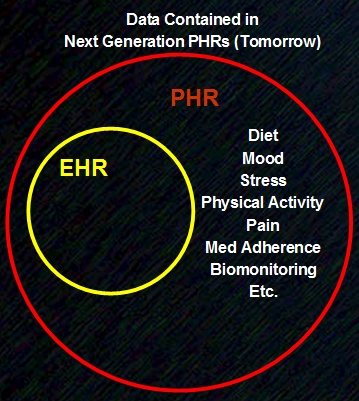
Back to Kuraitis' blogpost, called From PHRs to PHRSs.
After Katharina, in the US the idea that the patient should have his own record, a PHR, which should be independent from the "pure" medical record, was given an enormous impulse. (for more see Paul Tang et al.) From that moment on I have been fighting this concept in many of my blogs, articles and speeches.

Now, in his blog, Kuraitis turns around the wheel completely. (see picture)
You can discuss whether it should be the way Kuraitis proposes or the way I have been promoting, where the PHR is an integral and equal part of the EHR, i.e. PHR + EMR = EHR.

But the fact that it took 3 years to come up with the concept that the new generation PHR should be an integrated record where I, and many others with me, have been saying this over and over again, makes me an impatient patient.


Tuesday, September 16, 2008

E.R. Patients Often Left Confused After Visits

E.R. Patients Often Left Confused After Visits
Published: September 16, 2008
From the article:

Many emergency room patients are discharged without understanding how to care for themselves once they get home, researchers say.

In the past, patients who did not follow discharge instructions were often labeled noncompliant. “Now, it’s being called health illiteracy,” Dr. Coleman said, adding that as many as half of all patients are considered to lack the ability to process and understand basic health information that they need to make decisions.

But the patient is only part of the equation, he continued; doctors are notoriously inept at communicating to patients.

The new study found that people were not aware of what they did not understand, suggesting that simply asking a patient if he understands is not enough.

“We’re good at saying, ‘Here’s the information, any questions?,’ ” Dr. Coleman said, “and the person nods his head, but they don’t get it.”


Marina: It all boils down to a lack of information...and ability to transfer information...

Monday, September 15, 2008

Afterthoughts of the CNN interview.

CNN gets between 25 to 35 Million visitors a month according to Compete Site Analytics. I asked Ms. Elizabeth Cohen about the impact she though her column had and she did not know.

To learn about her readership and impact I believe Ms. Cohen should aligning her column with the Web 2.0 momentum and perhaps consider:
  1. Opening a Facebook account so empowered patients can learn about her life and column at CNN.
  2. Opening a Twitter account to send updates on how the columns are evolving.
  3. Letting fans write a chapter of Elizabeth's new book on smart patients, following the example of Freakonomics.
  4. Developing an open, user friendly, web platform where the readership can:
  • See a list of topics currently in production.
  • Suggest new topics for the column.
  • Rate the topics according to preference and priority.
  • Delete topics not of interest to empowered patients.
  • Recommend sources of information, search engines, blogs.
  • Connect with other fellow empowered patients and create a community.
As for ideas for new columns I suggest (please note the journalistic style...):
  • 5 things you need to know if you are going to self-medicate.
  • Who should think about a 'living-will'?
  • Myths and misconceptions about organ donation.
  • How to talk about death with your loved ones?
  • Superbugs and the problem with antibiotics.
  • Why are we still talking about washing hands in the 21st century?
  • The obnoxious patient (part 2): when being "too-good" of an empowered patient may put you at risk.
  • Finding a Doctor 2.0.
  • 5 Mistakes to avoid while using Email or the Phone with your doctor.
  • Are Electronic Personal Health Records something you need?
  • How to benefit from like-patient social networks?
  • Finding reliable health information that matters to you: How to set up an RSS reader.
What do you think and what are your suggestions?

Carlos Rizo

Friday, September 12, 2008

The 'too-empowered' Im-Patient

The interview with Elizabeth Cohen, columnist and medical correspondent for CNN went well. Elizabeth wanted to explore the risks of being "too-good-of-a-good-patient' and when and how this could compromise care. Most of the conversation centered around my personal vignette on the British Medical Journal article entitled "I am a good patient, believe it or not" published with two of my mentors. Here is the vignette:
The health professional who catheterised me after my recent appendectomy used the anaesthetic gel simply as lubricant, without waiting for the anaesthetic to take effect. Neither I nor my wife, who is also a doctor, openly questioned the neglect of this simple precaution, which converted an unpleasant procedure into an unnecessarily painful one. Why did we let that happen? Did we think that being passive and compliant made me a good patient? Or were we just too afraid to question the authority of our caregiver?
Revisiting the experience over and over to get clarification on the questions was painful but not as painful as the experience itself. There are advantages and disadvantages of being too-empowered and only through our own journeys we'll be able to find the right level of empowerment for each situation. Good luck... it changes all the time.

Books on Doctors as Patients and a few on the Doctor-Patient Relationship